
New Section 179 rules allow immediate deduction of up to $2,500,000 in equipment purchases. Meanwhile, lease payments are now less deductible under new IRS guidelines. Choosing wrong in 2025 can cost you $50,000+ in lost tax benefits.
70% of businesses choose the wrong equipment acquisition strategy, paying 30-50% more than necessary over the asset’s life. This guide reveals the true total cost of ownership (TCO), hidden lease penalties, and the section 179 tax loophole that can make financing dramatically cheaper.
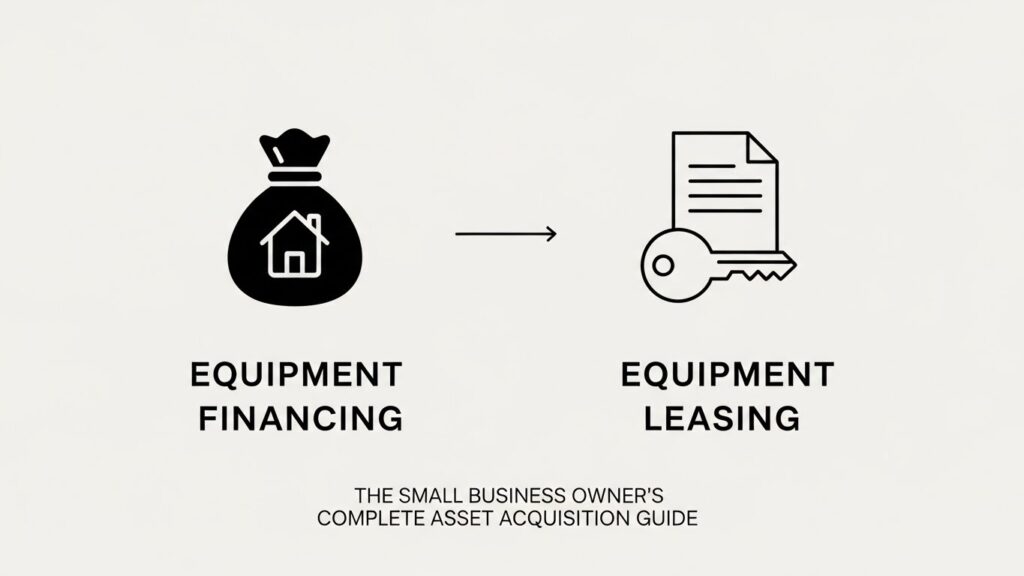
Quick Comparison: At a Glance
| Feature | Equipment Financing (Loan) | Equipment Leasing |
| Ownership | YOU own the equipment | LESSOR owns the equipment |
| Payment Structure | Monthly principal + interest | Monthly rental payment |
| Upfront Cost | 10-20% down payment | $0 down (most leases) |
| Interest Rate/APR | 4-34% APR (avg 8-18%) | Not disclosed (implied rate 8-30%) |
| Term Length | 2-7 years (match equipment life) | 2-5 years (often renewable) |
| End of Term | Own equipment free & clear | Return, renew, or purchase |
| Tax Treatment | Section 179 deduction + depreciation | Lease payments deductible as expense |
| Maintenance Responsibility | YOU pay for all repairs | Often included in lease |
| Obsolescence Risk | YOUR risk (equipment depreciates) | LESSOR’s risk (you upgrade) |
| Balance Sheet Impact | Asset & liability listed | Off-balance sheet (operating lease) |
| Best For | Long-life assets (7+ years), stable needs | Rapidly evolving tech, short-term needs |
| Typical Use | Machinery, vehicles, furniture | Computers, software, medical equipment |
Equipment Financing: The Ownership Path
What Is Equipment Financing?
Equipment financing is a term loan specifically used to purchase business equipment. The equipment serves as collateral, making it easier to qualify than unsecured loans.
Key Distinction: You own the equipment from day one (with a lien from the lender until paid off).
How Equipment Financing Works
Structure:
- Select Equipment: Choose new or used equipment from any vendor
- Down Payment: Pay 10-20% of equipment cost
- Loan Amount: Financer funds 80-90%
- Monthly Payments: Fixed principal + interest
- Ownership: You own equipment after final payment
Example:
- Equipment Cost: $100,000 (industrial printer)
- Your Down Payment: $15,000 (15%)
- Loan Amount: $85,000
- Interest Rate: 10% APR
- Term: 5 years (60 months)
- Monthly Payment: $1,808
- Total Repaid: $108,480 ($15K + $93,480 in payments)
- Total Cost: $108,480
End of Term: You own a $100,000 printer (worth $30,000-$40,000 residual value).
Types of Equipment Financing
- Fixed term: 2-7 years
- Fixed payments: Monthly principal + interest
- Best for: Machinery, vehicles, long-life equipment
2. Equipment Line of Credit:
- Revolving credit: Up to $500K limit
- Draw as needed: For multiple equipment purchases
- Best for: Businesses frequently acquiring equipment
- SBA guarantee: Lower down payment (0-10%)
- Longer terms: Up to 10 years
- Rates: Prime + 2.25-4.75% (9.5-13.25% currently)
- Best for: Established businesses with strong financials
4. Hard Money Equipment Loan:
- Asset-based: Qualify on equipment value, not credit
- Fast funding: 3-7 days
- Rates: 12-25% APR
- Best for: Urgent equipment needs, credit challenges
Pros & Cons of Equipment Financing
Advantages:
- Section 179 deduction: Deduct up to $2500,000 in year one (2025 limit)
- Ownership: You own an asset that retains residual value
- Depreciation benefits: MACRS depreciation over 5-7 years
- No usage restrictions: Modify, customize, or relocate equipment
- Lower total cost: 20-40% cheaper than leasing over 7+ years
- Equity building: Equipment appears on balance sheet as asset
- Flexible terms: Match payment term to equipment useful life
Disadvantages:
- Down payment required: 10-20% upfront cash
- Maintenance responsibility: All repair costs are yours
- Obsolescence risk: Stuck with outdated equipment
- Balance sheet impact: Increases debt-to-equity ratio
- Qualification barrier: Requires decent credit (620+)
- Slower approval: 3-10 days vs. instant lease approval
Tax Benefits of Equipment Financing: Section 179
Section 179 Deduction:
- Maximum Deduction: $2,500,000
- Equipment Cost Limit: $3,050,000 (deduction phases out above this)
- Eligible Equipment: New or used, purchased/financed in 2024
- Vehicle Limit: $30,500 for heavy SUVs
How It Works:
- Purchase equipment: $150,000
- Section 179 deduction: Deduct full $150,000 in Year 1
- Tax Savings: $150,000 × 25% tax rate = $37,500 tax savings
- Net Equipment Cost: $112,500
Bonus Depreciation:
- 80% bonus depreciation for qualified property
- Use if Section 179 limit exceeded
- Or use together: Section 179 for first $1.22M, then 80% bonus on remainder
Comparison to Lease: Lease payments are only deductible as paid (e.g., $2,000/month × 12 = $24,000 deduction). Section 179 gives you $150,000 deduction immediately.
Real ROI Example: Equipment Financing with Section 179
Client Profile:
- Business: Manufacturing (C-Corp, 25% tax rate)
- Equipment: CNC machine ($250,000)
- Financing: $50,000 down + $200,000 loan at 9% APR for 5 years
- Monthly Payment: $4,152
- Total Cost: $299,120
Tax Benefits:
- Section 179 Deduction: $250,000 (Year 1)
- Tax Savings: $250,000 × 25% = $62,500
- Net Equipment Cost: $236,620
Residual Value (Year 5):
- Equipment Resale Value: $75,000 (30% of original)
- Total Net Cost: $236,620 – $75,000 = $161,620
Revenue Impact:
- Additional Revenue from Machine: $400,000/year
- Gross Profit: $160,000/year (40% margin)
- 5-Year Gross Profit: $800,000
- Net ROI: $800,000 – $161,620 = $638,380
When Equipment Financing Makes Sense: You have stable, long-term equipment needs and can take advantage of Section 179 tax benefits.
Equipment Leasing: The Usage Model
What Is Equipment Leasing?
Equipment leasing is a rental agreement where the lessor (owner) allows you to use equipment for a fixed monthly payment over a set term, with end-of-lease options.
Key Distinction: You NEVER own the equipment unless you exercise a purchase option at the end.
How Equipment Leasing Works
Structure:
- Choose Equipment: Lessor purchases equipment from vendor
- Lease Agreement: Sign 2-5 year lease
- Monthly Payment: Fixed payment includes usage, maintenance (sometimes)
- End of Term: Choose from purchase, return, or renew options
Example:
- Equipment Cost: $100,000 (industrial printer)
- Lease Term: 4 years (48 months)
- Monthly Payment: $2,200
- Type: Operating Lease (FMV buyout)
- Total Paid Over 4 Years: $105,600
End of Lease Options:
- Return: Give equipment back, lease new model
- Renew: Extend lease at reduced payment
- Purchase (FMV): Buy at Fair Market Value ($20,000)
- Total Cost if Purchased: $125,600
Types of Equipment Leases
1. Fair Market Value (FMV) Lease:
- Lowest Payments: Because lessor retains residual value risk
- End-of-Term: Purchase at fair market value (or return)
- Tax Treatment: True lease (off-balance sheet, payments deductible)
- Best For: Technology that obsoletes quickly
2. $1 Buyout Lease (Capital Lease):
- Higher Payments: Because you’re financing 100% of cost
- End-of-Term: Buy for $1 (essentially financing)
- Tax Treatment: Treated as purchase (Section 179 eligible)
- Best For: When you know you’ll own the equipment
3. 10% Option Lease:
- Middle Payments: Between FMV and $1 buyout
- End-of-Term: Buy for 10% of original cost (or return)
- Best For: Equipment with moderate residual value
4. Terminal Rental Adjustment Clause (TRAC) Lease:
- For Vehicles: Trucks, commercial vehicles
- Flexible end-of-term: Pre-agreed residual value
- Best For: Vehicle fleets with predictable depreciation
Pros & Cons of Equipment Leasing
Advantages:
- $0 down payment: Preserve cash (most leases)
- Predictable payments: Fixed monthly cost
- Maintenance included: Many leases include service contracts
- Obsolescence protection: Easy upgrade to newer equipment
- Tax deductible: Lease payments 100% deductible (operating leases)
- Off-balance sheet: Operating leases don’t appear as debt
- Easier approval: Less stringent credit requirements
- Fast approval: 24-48 hours vs. 3-10 days for financing
Disadvantages:
- Higher total cost: 20-50% more expensive over equipment life
- No ownership: Never build equity in the equipment
- Never-ending payments: Lease renewals = perpetual payments
- Usage restrictions: Can’t modify or relocate without permission
- Early termination penalties: Breaking lease costs 20-50% of remaining payments
- Maintenance restrictions: May require using lessor’s service providers
- Credit impact: Not reported to business credit bureaus
- Tax disadvantage: Can’t use Section 179 (operating leases)
Tax Treatment of Leases: Operating vs. Capital
Operating Lease (FMV Lease):
- Not a purchase: IRS treats as rental
- Deduction: Lease payments deductible as business expense
- Example: $2,200/month × 12 = $26,400 annual deduction
- No depreciation: Cannot depreciate equipment (you don’t own it)
Capital Lease ($1 Buyout Lease):
- Treated as purchase: IRS sees as financing
- Deduction: Can use Section 179 (if written into lease)
- Depreciation: Can depreciate equipment over useful life
- Balance Sheet: Equipment appears as asset and liability
2024 IRS Change: Stricter rules on what qualifies as operating lease. Many leases previously treated as operating must now be capital leases.
Real ROI Example: Equipment Leasing (FMV)
Client Profile:
- Business: Graphic design agency (S-Corp, 30% tax rate)
- Equipment: High-end computers & software ($75,000)
- Lease: 3-year FMV lease, $2,200/month
- Technology Obsolescence: Replace every 3 years
Lease Analysis:
- Total Lease Payments: $79,200 ($2,200 × 36)
- Tax Deduction: $79,200 × 30% = $23,760 tax savings
- Net Lease Cost: $55,440
- End of Lease: Return equipment, lease new $75K setup
Comparison to Financing:
- If purchased: $75,000 + interest = $85,000 total
- Section 179 deduction: $75,000 × 30% = $22,500 tax savings
- Net cost: $62,500
- Savings with Lease: $62,500 – $55,440 = $7,060 over 3 years
When Leasing Makes Sense: Technology obsoletes in <5 years and you want tax deduction benefits without ownership hassle.
Head-to-Head: 7-Year Total Cost Analysis
Scenario: $150,000 CNC Machine, 7-Year Useful Life
| Cost Factor | Equipment Financing | Equipment Leasing (FMV) |
| Down Payment | $22,500 (15%) | $0 |
| Monthly Payment | $2,076 | $3,100 |
| Total Payments (7 yrs) | $196,884 | $260,400 |
| Tax Deduction | $150,000 (Section 179) | $260,400 (lease payments) |
| Tax Savings (25%) | $37,500 | $65,100 |
| Residual Value | $45,000 (sell used) | $0 |
| 7-Year Net Cost | $114,384 | $195,300 |
| Cost Difference | Financing saves $80,916 |
Winner: Equipment financing is 41% cheaper over equipment life, even with higher Section 179 deduction for lease.
Decision Framework: Finance vs. Lease
Choose EQUIPMENT FINANCING If:
Copy
Equipment Life > 5 Years AND You Have 10-20% Down Payment?
├── YES → Finance
│ └── Will Equipment Retain Value? → Finance
│ └── Want Section 179 Deduction? → Finance
└── NO → Consider lease
Examples of Equipment to Finance:
- Machinery (metalworking, woodworking, manufacturing)
- Commercial vehicles (trucks, vans, specialized vehicles)
- Restaurant equipment (ovens, refrigerators, furniture)
- Construction equipment (excavators, loaders, bulldozers)
- Agricultural equipment (tractors, combines)
- Medical equipment (durable, long-life devices)
Choose EQUIPMENT LEASING If:
Copy
Equipment Obsoletes in <3 Years OR You Need $0 Down?
├── YES → Lease
│ └── Does Lease Include Maintenance? → Lease
│ └── Will You Upgrade Frequently? → Lease
└── NO → Finance
Examples of Equipment to Lease:
- Computers & servers (tech changes every 2-3 years)
- Software (subscription-based models)
- Office copiers/printers (service contracts included)
- Medical imaging equipment (rapid tech advancement)
- Event/AV equipment (short-term needs)
- Specialized equipment for one-time projects
Hybrid Strategy: Finance + Lease
Smart businesses use both:
Finance:
- Core equipment you use daily (machinery, vehicles)
- Equipment with long useful life (>5 years)
- Assets that retain value
Lease:
- Technology that updates frequently (computers, software)
- Equipment with bundled maintenance (copiers, specialized tools)
- Short-term project needs
Example: Manufacturing company finances CNC machines (7-year life) and leases office computers (3-year replacement cycle).
Special Situations: What to Choose
Startup Businesses (<2 Years)
- Hard Money Equipment Loan: If you have collateral, can close in 5 days
- SBA 7(a) Equipment Loan: 0-10% down, 10-year term, but requires 2+ years
- Equipment Lease: Easiest approval, minimal docs, no down payment
- Verdict: Lease for first 2 years, then finance or SBA
Businesses with Strong Cash Flow (DSCR >1.5)
- Equipment Financing: Lowest total cost, build asset base
- SBA 7(a) Equipment Loan: Rates 2-3% lower than conventional
- Avoid leasing: You’re paying premium for flexibility you don’t need
- Verdict: Finance everything you can
Businesses with Seasonal Revenue
- Equipment Lease: Lower payments during off-season
- Equipment Line of Credit: Draw only when needed, pay interest-only
- Avoid: Fixed payment financing that strains cash flow in slow months
- Verdict: Lease or LOC for flexibility
Businesses with Rapidly Changing Technology
- Equipment Lease: Upgrade every 2-3 years without obsolescence risk
- Example: IT consulting firm leases servers, finances office furniture
- Verdict: Lease tech, finance hard assets
Tax Strategy: Maximizing Your Deduction
Section 179 Strategy (Financing)
2025 Limits:
- Deduction Limit: $2,500,000
- Spending Limit: $3,050,000 (phases out dollar-for-dollar above this)
- Bonus Depreciation: 80% for qualified property
Best For:
- High-revenue year: Offset profits with equipment purchase
- Growing business: Reduce taxable income, reinvest savings
- Equipment cost: $50K – $1.2M range
Example:
- Year 1 Profit: $500,000
- Equipment Purchase: $300,000 (financed)
- Section 179 Deduction: $300,000
- Tax Savings: $300,000 × 25% = $75,000
- Effective Equipment Cost: $225,000
Lease Deduction Strategy (Leasing)
Operating Lease:
- Deduct full lease payment each year
- 2024 annual limit: No cap on lease payment deduction
- Best for: Businesses that can’t use Section 179 (startup losses, low profit)
Capital Lease ($1 Buyout):
- Section 179 eligible (treated as purchase)
- Deduction timing: Year 1 (Section 179) + depreciation
- Best for: Want lease structure with purchase intent
Comparison:
- Finance $100K: Deduct $100K in Year 1 (Section 179)
- Lease $2K/month: Deduct $24K in Year 1 (lease payments)
- Winner: Financing gives 4x larger deduction in Year 1
Hidden Costs: What They Don’t Tell You
Equipment Financing Hidden Costs:
- Origination fees: 0.5-2% of loan amount
- Appraisal/inspection: $500-$2,000
- Insurance: Required to cover equipment
- Maintenance contracts: $2,000-5,000/year (not included)
- Total hidden costs: 3-5% of equipment cost
Equipment Leasing Hidden Costs:
- Origination/documentation fees: $500-$2,000
- Early termination penalty: 20-50% of remaining payments
- Excess mileage/use fees: Penalties for exceeding usage limits
- Return condition fees: Charges for wear beyond “normal”
- Buyout price markup: FMV lease buyout often 20-30% above true market value
- Total hidden costs: 10-15% of equipment cost (much higher)
Lease vs. Finance: Total Cost Winner
7-Year $150,000 Equipment:
- Financing Total Cost: $114,384 (net, after tax benefits)
- Leasing Total Cost: $195,300 (net, after tax benefits)
- Financing saves $80,916 (42% cheaper)
Next Steps: Get Equipment Without Overpaying
Don’t let equipment vendors steer you into expensive leases. Brookestone Funding offers both financing and lease options—we’ll show you the true total cost so you make the smart choice.
Equipment Financing Pre-Approval
- Up to $5M equipment loans
- Rates from 6% APR
- Section 179 guidance included
- Approval in 24 hours
- [Apply for Equipment Financing →]
Equipment Lease Options
- FMV, $1 buyout, and TRAC leases
- Maintenance packages available
- Technology upgrade programs
- Approval in 24-48 hours
SBA Equipment Loan
- 10-year terms
- 0-10% down payment
- Rates from 9.5% APR
- For established businesses
Equipment Line of Credit
- Revolving credit up to $1M
- Draw as needed for multiple assets
- Interest-only payments available
Questions? Talk to an Equipment Specialist
Our team has funded $250M+ in equipment for businesses nationwide. We’ll analyze your equipment lifecycle, tax situation, and cash flow to recommend the optimal structure.
📞 Call (877) 665-4209 | 📧 info@brookestonefunding.com
FAQs
Can I finance used equipment?
Yes. Brookestone Funding finances both new and used equipment (up to 10 years old). Section 179 applies to used equipment too.
What credit score do I need for equipment financing?
620+ for financing, 550+ for leasing. Hard money equipment loans available with lower scores if you have collateral.
Can I negotiate the end-of-lease buyout price?
Sometimes. FMV leases have preset buyout, but $1 buyout leases are fixed. Always negotiate buyout terms before signing.
Which is better for tax purposes: financing or leasing?
Financing is usually better due to Section 179 deduction. Leasing only allows deduction of lease payments. If you have high profits, financing saves more in taxes.
Can I cancel a lease early?
Yes, but it’s expensive. Early termination penalties typically equal 20-50% of remaining lease payments. Financing has no prepayment penalty after 12 months.
What’s the difference between a capital lease and operating lease?
Capital lease = financing (you own for tax purposes, requires $1 buyout). Operating lease = true rental (off-balance sheet, payments deductible).
Can startups get equipment financing?
Difficult. Most lenders require 2+ years in business. Startups should lease for 2 years, then finance.
How fast can I get equipment financing?
24-48 hours for equipment financing under $250K. Leasing can be same-day approval.
Should I finance or lease vehicles?
Finance for long-term use (company cars, delivery trucks you’ll keep 5+ years). Lease for short-term or if you want to upgrade every 2-3 years.
Can I use Section 179 if I finance equipment in December?
Yes! Section 179 applies to equipment placed in service by December 31, even if financed. You can get $1.2M deduction with $0 down payment.
About Brookestone Funding
Brookestone Funding is a nationwide direct lender specializing in equipment financing, leasing, and SBA equipment loans. We’ve funded $250M+ in equipment for businesses in manufacturing, construction, medical, restaurant, and technology sectors.
Our Equipment Advantage:
- Both financing and leasing under one roof (unbiased advice)
- Section 179 tax consultation included
- Fast approvals: 24-48 hours
- Competitive rates: 6-25% APR depending on program
- Flexible terms: 2-7 years financing, 2-5 years leasing